
EP Review: pixel in space – Preparing...
pixel in space is a husband-and-wife project out of St. Petersburg. In 2024 the two of them shut themselves in a studio there and wrote eighteen tracks. Preparing... is six of them, pulled out ahead of the full record — Well Done Journey — as a way in. Every instrument the band owned and knew how to play was thrown into the mix: synths and violins, guitars and voice, drum machines and samplers — thirty years of accumulated experience plus zero concern for stylistic rules and consistency.
Vladimir, who is one half of the duo, mixed and mastered the material over the summer in a remote forest village.
The results aren't going to every streaming service — just YouTube, Bandcamp and SoundCloud — plus cassettes, meticulously self-recorded by the band to ensure maximum sound quality.
The record starts with "Crank Up" that brings the old school vibes to the max right from the start: scratches, 808 cowbells, piercing acid synth lines, crisp boom-bap drums, dirty guitars and some juicy rap samples all go into the pot, like it's the infamous Irish stew from "Three Men in a Boat". Probably the biggest hook here is the upright bass riff, arresting your attention from the get-go. The vibe here is the one you've been missing for years: peak Fatboy Slim and Beastie Boys circa 1998's "Hello Nasty".
Vladimir, who is one half of the duo, mixed and mastered the material over the summer in a remote forest village.
The results aren't going to every streaming service — just YouTube, Bandcamp and SoundCloud — plus cassettes, meticulously self-recorded by the band to ensure maximum sound quality.
The record starts with "Crank Up" that brings the old school vibes to the max right from the start: scratches, 808 cowbells, piercing acid synth lines, crisp boom-bap drums, dirty guitars and some juicy rap samples all go into the pot, like it's the infamous Irish stew from "Three Men in a Boat". Probably the biggest hook here is the upright bass riff, arresting your attention from the get-go. The vibe here is the one you've been missing for years: peak Fatboy Slim and Beastie Boys circa 1998's "Hello Nasty".

Vladimir Matveev
The idea of the track has been around me since I was a child, and I grew up in an area where everyone was constantly building cars in the 00s and racing with each other. Constant tinkering with the petrolheads' engines produced a unique techno vibe. The creation of the track began with a guitar riff, which was born from an acoustic guitar with nylon strings passed through a guitar amp for heavy music. It gave an unusual sound and groove. Then the samples with the words crank up and the drums cooked on Casio FZ-1 put it all together.
I put a draft on an accelerated video from the 50s with Goofy, Donald Duck and Mickey, where they clumsily fix the car at speed - this gave an additional groove to me and then I tried to convey this groove in the bass part: the sampled double bass and the bass guitar part I played in bridge. Only the second theme was missing, and it became the 303 sequence distorted on the old sampler.
All this soup was flavored with the sounds of starters and the screeching of faulty engines, which finally conveyed the desired atmosphere of a crazy friday before the races, when everyone in the courtyards of apartment buildings, lying on the asphalt, made the final settings of their steel pets.
I put a draft on an accelerated video from the 50s with Goofy, Donald Duck and Mickey, where they clumsily fix the car at speed - this gave an additional groove to me and then I tried to convey this groove in the bass part: the sampled double bass and the bass guitar part I played in bridge. Only the second theme was missing, and it became the 303 sequence distorted on the old sampler.
All this soup was flavored with the sounds of starters and the screeching of faulty engines, which finally conveyed the desired atmosphere of a crazy friday before the races, when everyone in the courtyards of apartment buildings, lying on the asphalt, made the final settings of their steel pets.
"Move" continues the big beat line with a harsher, more streamlined attitude — think "Block Rockin' Beats" by The Chemical Brothers. Synths wail, weep and bubble around you like sirens from every direction at once, a chase closing in with you in the middle, and each one is a small hook in its own right.
At the risk of spoiling it a little: the track goes full ambient partway through, laying warm pads out in front of you like fresh sheets in front of an exhausted traveller — anxious electronica at its quietest, Underworld or Orbital or Moby's soundtrack work, or New Age at its murkiest, Delerium before Karma tidied them up.
At the risk of spoiling it a little: the track goes full ambient partway through, laying warm pads out in front of you like fresh sheets in front of an exhausted traveller — anxious electronica at its quietest, Underworld or Orbital or Moby's soundtrack work, or New Age at its murkiest, Delerium before Karma tidied them up.
Vladimir Matveev
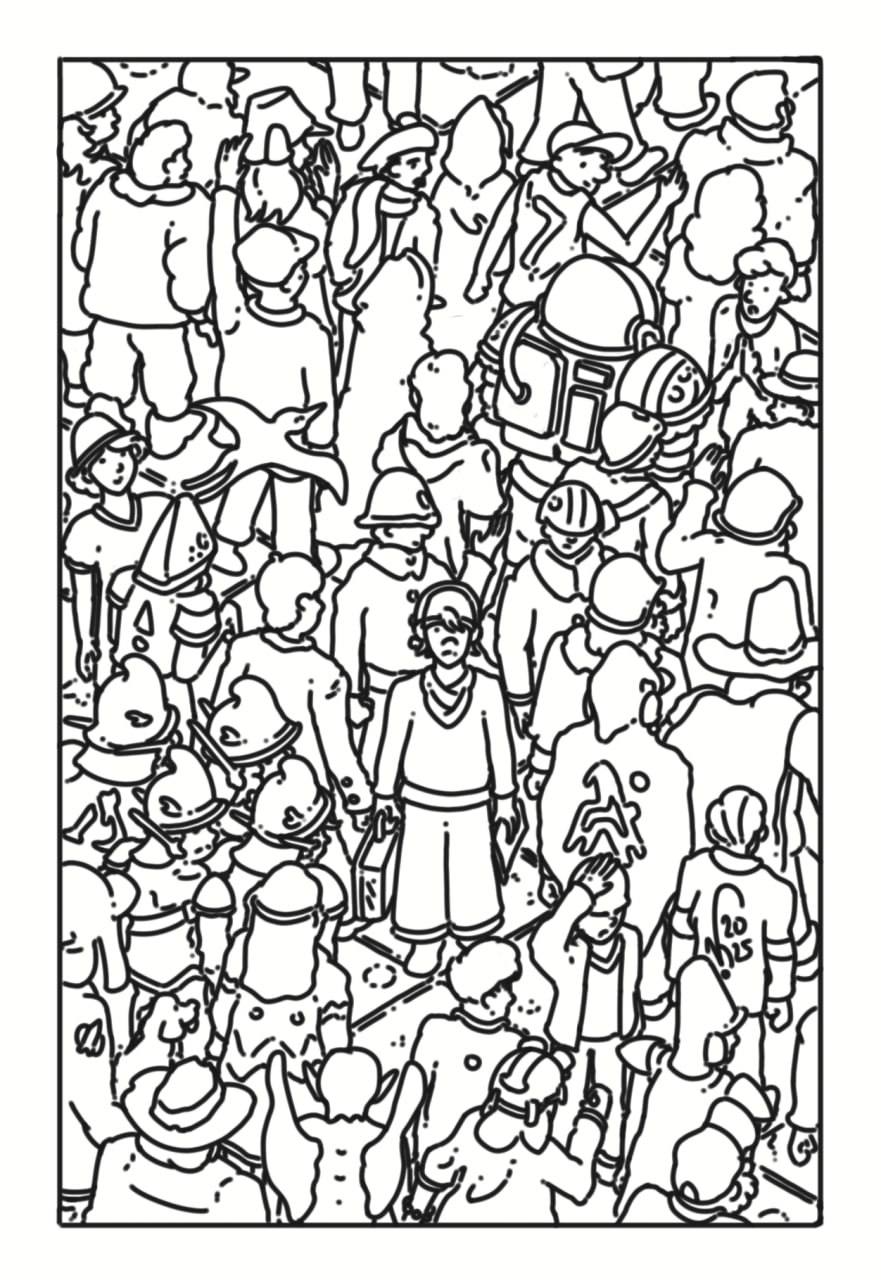
A sketch of the painting Move by Daniil Vlasenko, the artist who designed the EP, caught my eye at some point. I was then stuck with the idea of the last missing track for my LP Well Done Journey. This picture and the name immediately gave me a direction, and a reference from the Chrystal Method - The Name of the Game - sounded in my head. Tom Morello's simple but rocking riff immediately made me take bass guitar and plug it into two amplifiers, a guitar and a bass one. Then the SE ATC-1 and Novation Basstation Rack synthesizers were passed through different guitar amplifiers and pedals, and I always play on the keys, then only slightly editing the parts in the DAW. Everything screeched and creaked. When I finished some synthesizer riffs, my 14th yo daughter, who had been doing her homework behind the wall and was a fan of rock, came in and said she had never heard synthesizers so lively. So I realized that I was on the right track.
The bass line on "Not for Money" is even catchier than on "Crank Up" — pure gold. The drums are just as crisp, but the joyful, dreamy flute passages, the dubby fills and the old film dialogue samples all point to another late-90s/early-2000s source: a wave of intricate, sample-heavy easy listening which De-Phazz all but defined with Detunized Gravity and Godsdog.
Vladimir Matveev
I grew up in the old factory district in the 90s. Guy Ritchie's early films and their drive have always been clear to me. And the situations of the heroes such films like Lock, Stock and Two Smoking Barrels or Snatch, seem to be written off from our homies. There were some drum beat and several sampled tutti phrases for a year, but there was no main theme of the track. And here, in a conversation about the motivation of an underground musician, I replied to a friend, as I did 20 years ago: we are going through this journey not for money. Something clicked inside and a double bass riff gathered and everything else just fell into place in just a couple of hours. If Guy Ritchie returned to films about the adventures of street punks, he could safely take this track.
I hope to be forgiven for reaching for comparisons this often, but the kaleidoscopic nature of the music on Preparing... begs for it. And as someone who grew up on the equally kaleidoscopic records that fed into this EP, it gives me pure joy. "Crossroads of Hope" unlocked a few more of my early music memories. I won't repeat the ones already mentioned, but the dirty acoustic guitar here has Beck's "Loser" energy — music too lazy on the surface to hold together, with a core robust enough to feed generations. Bluesy samples thrown in for good measure summon the ghosts of forgotten blues singers the way Moby's Play did. And one more memory, not a musical one. The 8-bit injections put me back on the floor of my grandmother's bedroom, close enough to the screen that she'd tell me to move back before I ruined my eyes, playing Super Mario and Felix the Cat.
Vladimir Matveev
I've always wanted to encrustate the blues in a big beat track. The guitar riff was written by me 3 years ago and I couldn't find a shape around it until I found a phrase that talks about such a human phenomenon as hope. Next, 8-bit sounds, screeching 303 and funky drums gathered in a whimsical eclectic mix. I didn't want to move on to boring breaks. This track is an attempt to find a way out of the 90s into the 20s again without the mistakes of the commercial breaks path, which often sounds like neuroslope to me. There is something to work on further.
"Young Shoots" is the first track on the record that behaves like a song — verses, a shape you can follow — rather than a sound collage full of surprises. Even so, the voice works as one more element in the pattern, another thread in a carefully woven cloth. It crackles under a layer of distortion, comes apart into its component molecules, passes through a digital wall and emerges as a robotic likeness of itself.
It's nothing like the standard swinging, swaggering, funk-inflected rap delivery — the kind we heard sampled on the opening track. This sounds like rap read out by someone who isn't a rapper, and that somehow puts it closer to you. Possibly too close.
"Young Shoots" may be a more ordinary song, and by now the big beat interior has grown ordinary too — we've been living in it all record. And it's why the small details on the track hit you the way they do — like the pitched-up vocal samples that flicker once in a while, and you get what you'd get if a ghost turned up in your living room, or a Pokémon: you jump, you yelp, and then you start figuring out how to live with ghosts.
It's nothing like the standard swinging, swaggering, funk-inflected rap delivery — the kind we heard sampled on the opening track. This sounds like rap read out by someone who isn't a rapper, and that somehow puts it closer to you. Possibly too close.
"Young Shoots" may be a more ordinary song, and by now the big beat interior has grown ordinary too — we've been living in it all record. And it's why the small details on the track hit you the way they do — like the pitched-up vocal samples that flicker once in a while, and you get what you'd get if a ghost turned up in your living room, or a Pokémon: you jump, you yelp, and then you start figuring out how to live with ghosts.
Vladimir Matveev
I rarely write lyrics, but here is an attempt to return to the legacy of the Beastie Boys and RATM to remind of the younger generations, who always fail to live up to expectations and grow through the old world, like grass in spring through old leaves. It's not good or bad, it just needs to be accepted.
"Chill the Beat" brings in textures that are almost orchestral, ones that hold you like a warm southern night and at the same time come over you like the sudden onset of a heavy psychedelic drug. And behind all of it — knocks, rustles, as if inside a cave. And a nervous arpeggio shimmering like an insect beating against glass.
Perhaps everything before this was even, maybe, a little too comfortable — in that it was full of ear candy, of all the little treats that keep appearing every second somewhere at the edge of the song, never letting you get bored, constantly slipping you another hit of dopamine.
On top of that it really does give you the feeling of a sound you recognise, even if, like me, you didn't grow up on The Prodigy and Fatboy Slim — but in this case you may have grown up on other music or films that get sampled here.
It works not only for us old-timers but for the new generation too, the one used to a constant dopamine rush from TikTok and the rest. You could call this record a certain kind of ADHD pleasure, because it constantly keeps feeding your focus something vivid and exciting. Something interesting, something that pulls your attention onto itself. And so, against all that, to end the record on "Chill the Beat" — a composition this epic, this faintly anxious, this ambiguous in what it makes you feel — that's a champion move, because what it promises you, really, is new rooms and unseen beauty on the full-length album to come.
Perhaps everything before this was even, maybe, a little too comfortable — in that it was full of ear candy, of all the little treats that keep appearing every second somewhere at the edge of the song, never letting you get bored, constantly slipping you another hit of dopamine.
On top of that it really does give you the feeling of a sound you recognise, even if, like me, you didn't grow up on The Prodigy and Fatboy Slim — but in this case you may have grown up on other music or films that get sampled here.
It works not only for us old-timers but for the new generation too, the one used to a constant dopamine rush from TikTok and the rest. You could call this record a certain kind of ADHD pleasure, because it constantly keeps feeding your focus something vivid and exciting. Something interesting, something that pulls your attention onto itself. And so, against all that, to end the record on "Chill the Beat" — a composition this epic, this faintly anxious, this ambiguous in what it makes you feel — that's a champion move, because what it promises you, really, is new rooms and unseen beauty on the full-length album to come.
Vladimir Matveev
The track was born pretty quickly, although in two approaches with a difference of a year. First, panoramic percussion drums was made on sampler and drum machine and a sequence were created on Korg Polysix. Than a voice fragment was found. A year later, I decided to go through the cassettes of my youth and found there an almost complete Aphex Twin collection. It's been a long time since I've listened to Richard James so much. Sitting down at the keys of the Roland JX3P, an airy, but at the same time weighty sound quickly turned out, and the chords of the main sequence came out from under the fingers, the bass and counter sequence on the 303 were born instantly. A little glitch in voice sampling and a minimalistic response to the bygone complex simplicity of the IDM dawn has found form and content.
While we wait for the album, the EP is worth returning to, and returning to again. There are doors in it that don't open on the first pass, small details it's been stuffed with, mood swings that come at you like a rollercoaster, and the mixing and mastering that's been handled with care, taste and fantasy.
And beyond everything I've described — the influences, the samples, the postmodernistic collage — the thing worth attending to is that there's an authorial hand here, and it only reveals itself across the whole, rather than in pieces. The closing track is where this becomes clear: it turns a light on everything that came before and gives it depth.
I'm waiting for the album with real interest, partly to understand that hand more precisely, to get closer to it. Because what this sounds like is the arrival of a deep, serious artist — or rather a partnership of two — intelligent, self-directed, with an enormous amount of listening behind them, vivid imagination and an inner spiritual life you can hear in the work, of which this EP has shown us only the tip.
And beyond everything I've described — the influences, the samples, the postmodernistic collage — the thing worth attending to is that there's an authorial hand here, and it only reveals itself across the whole, rather than in pieces. The closing track is where this becomes clear: it turns a light on everything that came before and gives it depth.
I'm waiting for the album with real interest, partly to understand that hand more precisely, to get closer to it. Because what this sounds like is the arrival of a deep, serious artist — or rather a partnership of two — intelligent, self-directed, with an enormous amount of listening behind them, vivid imagination and an inner spiritual life you can hear in the work, of which this EP has shown us only the tip.